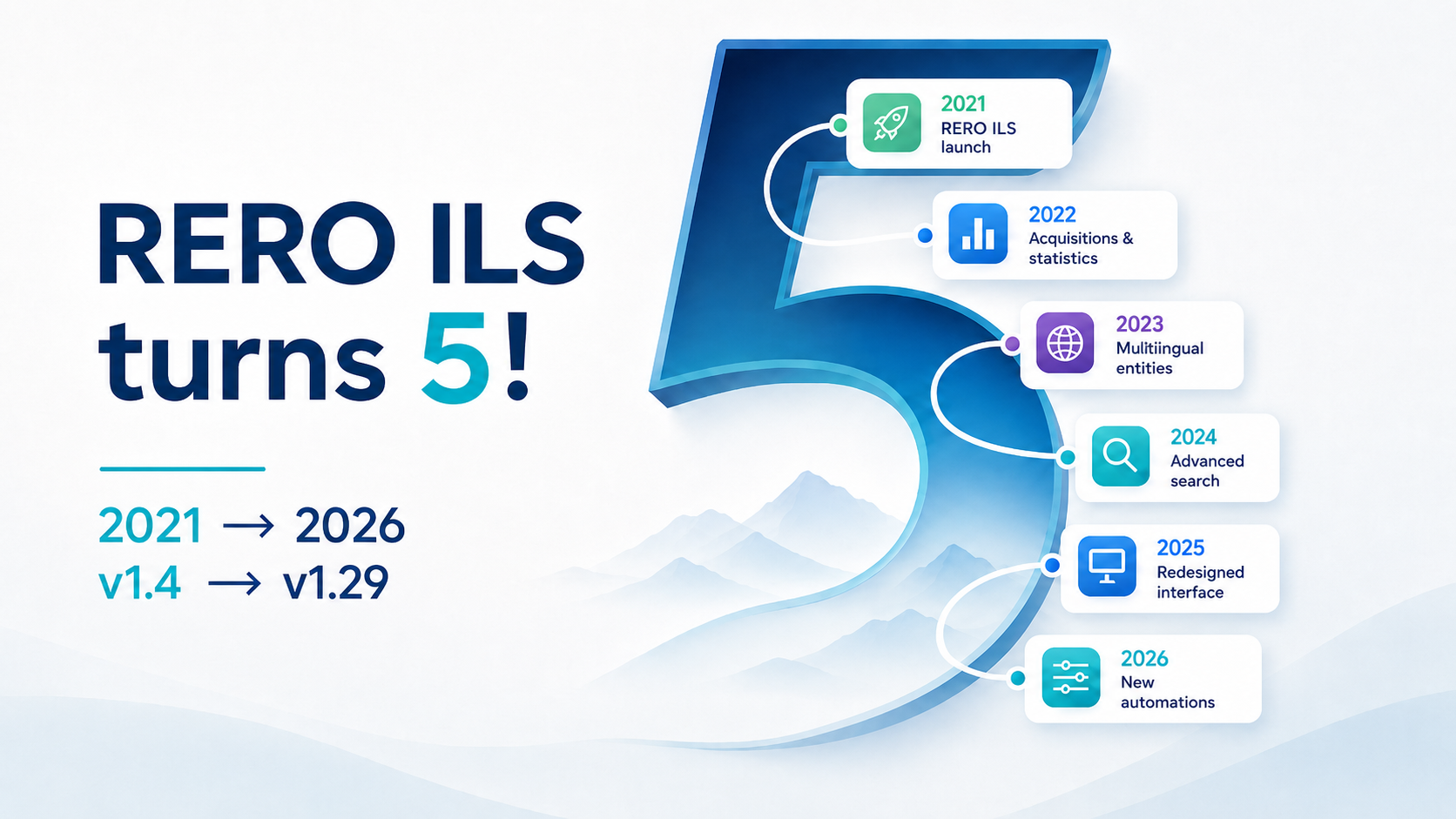
On July 12, 2021, version 1.4 of RERO ILS was deployed in production for the first time across the Valais library network, RBNJ (Neuchâtel-Jura), and the libraries of Bulle. Five years later, to the day, the system has reached version 1.29.0 — twenty-five “major steps” later. A good opportunity to look back at the most significant milestones of this journey.
First steps... then a fast start
The launch of new services (RERO ILS, SONAR) was also an opportunity for RERO+ to modernize its IT infrastructure, with the creation of new virtual servers and the adoption of “dockerization” (containerization) for deploying certain software components. Despite the risks associated with such a radical change, which also involved adopting many new technologies, the choice was clear: this transition required a fundamental technology shift. The IT team therefore needed several days to become familiar with all these new technologies in a production environment and to find the right settings to achieve the expected performance. A stabilization phase was therefore necessary, with some initial performance issues, but the expected level of service was quickly achieved.
On the software development side, the pace was intense from the first months of production: by March 2022, barely eight months after go-live, RERO ILS had already taken “five major steps” forward and fixed nearly 160 issues reported by libraries. (“RERO ILS: an update after 8 months in production”, March 10, 2022). Two major new modules were introduced during this period:
2022: expansion and enrichment
-
New module: Acquisitions. Launch of comprehensive order management: placing orders with suppliers, recording their receipt, and managing budget accounts. This first building block was expanded over subsequent releases (budget rollover, expense management, CSV export, etc.).
-
New module: Statistics. Access, for each library, to 10 key indicators, with monthly and annual reports — the first step toward a module that would become fully configurable in 2023.
-
Export to a reference manager: records can now be exported in RIS or JSON format for use with Zotero, EndNote, or Citavi.
-
Enhanced search facets (online/physical filters, new facets by year, genre/form, and target audience) and a list of related documents, allowing users to navigate easily between a record and its articles or volumes.
In summer 2022, the first anniversary prompted a satisfaction survey among about a hundred librarians across the network: around 60% said they were fairly satisfied with the system. The circulation and cataloguing functions were particularly appreciated, as was the usability of the new interface — judged modern, intuitive, and far more pleasant than the previous system.
2023: more refinement, more autonomy
-
Overhaul of staff roles: a move to granular permissions (cataloguing, circulation, acquisitions, patron management, etc.), freely combinable according to each library's needs.
-
MEF–RERO ILS synchronization to strengthen multilingual support. Until then, authority data (authors, subjects) was only imported from MEF (Multilingual Entity File, developed in-house) when a link was created in a record. An automatic synchronization mechanism now ensures that any change made in the external authority files (IdRef, GND) — the merging of two entities, for example — is reflected directly in RERO ILS.
-
Local entity management. Libraries not using MEF can now catalogue and manage their own entities (persons, corporate bodies, subjects, places, works) directly in RERO ILS, alongside links to external authority files.
-
Custom configuration of statistical reports. Librarians can create and edit their own report configurations (choice of indicator, filters, data combinations), with automatic generation of monthly or annual CSV reports.
2024: search, digital library, and multilingualism
-
Advanced document search. A guided form makes it possible to build an expert query by combining fields and Boolean operators, without needing to know the syntax.
-
Entity browsing. Clicking on an author, a subject, or any other entity linked to a record directly opens a search for all documents associated with it.
-
Adding files to library documents. Cataloguing librarians can now upload files linked to a record, with previews and thumbnails for images and PDFs, as well as full-text search within their content. This feature replaces the legacy RERO DOC service for RERO+ clients. The transition was completed a year and a half later, when RERO DOC closed permanently at the end of 2025, with RERO ILS and SONAR fully taking over its functions. (see “RERO DOC hands over the torch, discovery continues”)
-
Enriching documents with Babelio. Thanks to the Babelthèque service, records can dynamically display reader reviews, related documents, and tags from Babelio.
-
Automatic loan renewal: no more worrying about a missed due date — networks and libraries can now enable automatic renewals.
-
Data migration module. New libraries joining a RERO ILS network receive a tool to check the quality of their data conversion, followed by a deduplication mechanism that automatically searches for matches in the existing database — greatly reducing manual verification work.
-
German subjects and places (GND). A new version of MEF makes it possible to index simultaneously in French and German, in a single operation, without needing to master both languages: a subject indexed in French using RAMEAU is automatically linked to its German GND equivalent, where a match exists, and vice versa. This project, carried out at the request of the Médiathèque Valais, particularly benefits collections with little or no textual content (nearly 45,000 images and 27,000 scores), which can now be searched by subject in both languages.
2025-2026: new visual chapters
-
Complete interface overhaul: migration to Angular 19, PrimeNG, and Tailwind CSS, replacing Bootstrap — a months-long project that modernizes the application's appearance and makes future development easier.
-
Barcode display directly in the patron account.
-
New open-source mechanism for retrieving cover images.
-
Automatic removal of inactive patrons, based on criteria customizable by each library.
How does the service continue to evolve?
Since its launch, RERO ILS has remained true to its open-source approach. Its source code is freely accessible, development work is transparent, and the improvements made benefit the entire community.
At a steady pace of four releases per year on average, RERO ILS continues to be developed according to libraries' needs. Close collaboration between the foundation and its clients/partners makes it possible to focus development efforts on their requests.
When a library expresses a need, the specifications are drafted collaboratively. Once the development has been approved by all parties, the development, testing, and deployment cycle is generally short (3 to 6 months), allowing the feature to be deployed to production quickly. This participatory approach also makes it possible to adjust development priorities continuously.
The close relationship between the foundation and its clients/partners is an essential success factor in this model: in practice, they operate as a single team.
What you don't see
Behind the visible milestones of each new release lies continuous work that is less spectacular but just as essential: performance stabilization and optimization, security management, data migrations between releases, internal overhauls, technical dependency updates, and bug fixes. A significant amount of effort is dedicated to keeping the IT infrastructure and software aligned with current best practices.
It is also this behind-the-scenes work that allows RERO ILS, five years after its launch, to continue evolving according to the needs of those who use it every day.
5 years, thank you!
Thank you to all the libraries, librarians, and developers who have kept RERO ILS alive and growing over the past five years!